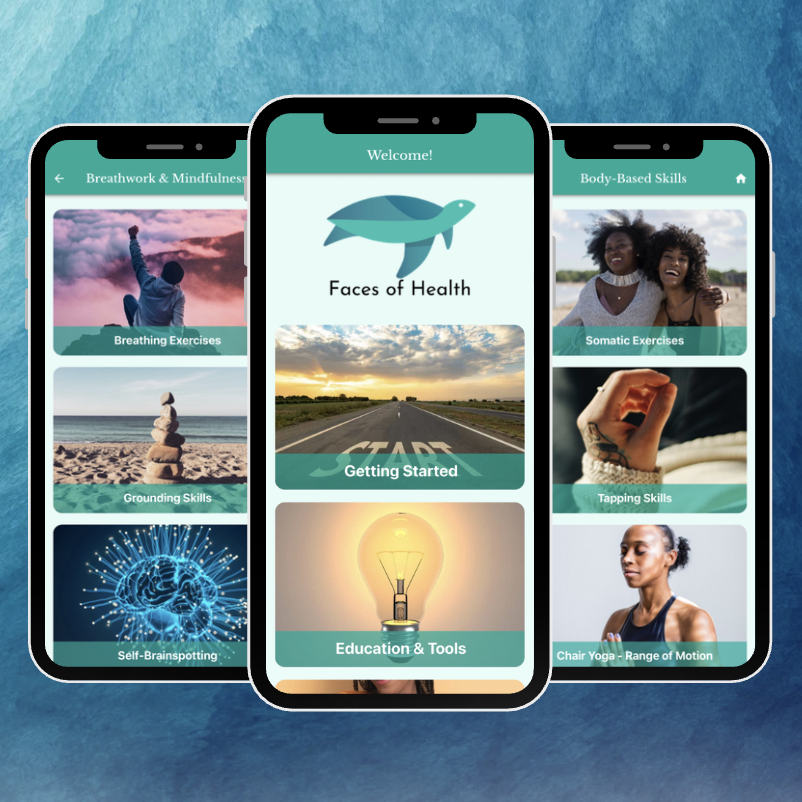
Faces of Health helps colleges, healthcare organizations, counseling centers, EAPs, and employers support adults navigating ADHD, autism, chronic illness, executive functioning differences, and chronic stress. Our psychologist-developed courses and daily-practice app provide practical, culturally responsive tools people can use between appointments, trainings, and semesters.
Faces of Health partners with organizations that want to offer adults more than general wellness information or a referral list. Our courses and daily-practice app provide structured, clinically grounded tools for people navigating ADHD, autism, chronic illness, executive functioning differences, and chronic stress.
Support neurodivergent students, students living with chronic health conditions, and learners who need practical tools for stress management, executive functioning, self-understanding, and day-to-day follow-through.
Give clients and patients accessible skills they can practice between appointments, while extending the impact of psychoeducation, treatment, care coordination, and whole-person health services.
Offer population-specific resources for employees managing neurodivergence, chronic illness, stress, and fluctuating capacity—without relying solely on one-time referrals or generic wellness content.
Provide scalable, practical learning that supports stress management, executive functioning, engagement, well-being, and more sustainable participation in work and daily life.
Faces of Health may be a strong fit when your organization wants culturally responsive, neuroscience-informed resources that people can return to between sessions, trainings, appointments, and semesters.
People are leaving therapy sessions, medical appointments, trainings, and semesters without enough practical support for what comes next. This is not because clinicians, educators, or organizational leaders are not doing their jobs. It is because tools designed specifically for neurodivergent adults, people managing chronic illness, and people whose stress lives in both their mind and body have not been widely available.
Faces of Health was built to help fill that gap. We give organizations clinically grounded, culturally responsive resources that people can return to between appointments, trainings, and semesters—not just information they encounter once and are then expected to implement on their own.
Many organizations want to better support adults with ADHD and autism but lack practical, evidence-based tools that translate understanding into daily functioning, communication, executive functioning, and follow-through.
Employees, students, clients, and patients living with chronic illness are often expected to keep functioning without systems that account for pain, fatigue, fluctuating capacity, and the executive functioning impact of ongoing health stress.
Stress affects attention, memory, decision-making, energy, and physical health. Many wellness solutions still rely primarily on awareness rather than helping people build repeatable skills they can use in real life.
People continue working on their health, functioning, and well-being between sessions, appointments, trainings, and semesters. They need something practical and accessible to return to during that space.
Faces of Health helps organizations support people impacted by neurodivergence, chronic illness, and chronic stress with tools that are brief, actionable, and designed for real-world use. In just a few minutes a day, people can begin strengthening skills that support attention, energy, stress regulation, and more sustainable participation in work, school, relationships, and daily life.
This is what it looks like when people have tools designed for how they actually live.
How It Works
Faces of Health combines structured learning, brief daily practice, and meaningful engagement data to help organizations support lasting follow-through—not just sign-ups, log-ins, or one-time awareness.
Evidence-based courses translate science into practical, usable skills for neurodivergence, chronic illness, executive functioning, and stress.
The Faces of Health app reinforces those skills in just 2–5 minutes per day, helping people practice what they learn in real life and between appointments, trainings, and semesters.
Engagement and outcome reporting help organizations monitor use, support implementation, and connect participation to broader well-being, retention, and performance goals.
The courses provide the learning. The app provides the daily practice. Together, they support real change.
Courses & Daily Practice
Faces of Health combines structured learning with brief, practical tools people can return to in daily life. Our two flagship courses provide the education, while the Faces of Health app supports continued practice between appointments, trainings, semesters, and other formal services.
This self-paced course helps adults, clinicians, educators, and families better understand ADHD, autism, executive functioning, and neurodivergence through a practical, strengths-forward lens.
Participants learn research-informed strategies they can apply to everyday functioning, communication, self-understanding, and support planning.
This self-paced course explains how chronic stress affects the brain and body while teaching practical, evidence-based tools for mindfulness, nervous-system regulation, and sustainable stress management.
It is especially relevant for people navigating chronic stress, chronic illness, pain, burnout, caregiving demands, or high-pressure professional roles.
The free Faces of Health app gives participants brief, on-demand tools they can use in approximately 2–5 minutes. The app includes practical support for grounding, stress management, mindfulness, emotional well-being, executive functioning, chronic illness, pain management, and whole-person health.
For organizations, the app extends learning beyond a single course or training by giving people a practical place to return to between appointments, semesters, workshops, and other formal services.
Faces of Health is different because the resources are developed by a licensed clinical psychologist who understands neurodivergence, chronic illness, disability, stress, and whole-person health from both professional and lived perspectives.
The content is research-informed without feeling overly clinical or difficult to use. Complex psychological and neuroscience concepts are translated into brief, practical strategies that people can apply in real life—even when their time, energy, attention, or physical capacity is limited.
Representation is also central to the Faces of Health mission. The platform intentionally increases the visibility of Black women doctors and other diverse professionals while providing culturally responsive resources that recognize the ways identity, health, disability, family roles, faith, and life experiences can shape well-being.
Faces of Health helps organizations offer resources that are clinically grounded, personally meaningful, and designed for the realities of how people actually live.
Faces of Health is designed to be more than engaging. Participants and organizational partners describe the resources as practical, credible, culturally responsive, and useful for supporting meaningful follow-through in daily life.
Partnership Options
Faces of Health partnerships can be tailored to your organization’s audience, size, priorities, and desired level of implementation support. Options range from focused pilots to larger institutional partnerships that combine courses, app-based practice, live learning, and engagement support.
Foundational Pilot
A Foundational Pilot offers a practical way to introduce Faces of Health resources to a defined group, department, cohort, or campus population.
Typical investment: $12,000–$18,000
Growth Partnership
A Growth Partnership supports broader implementation across multiple groups, departments, programs, or organizational initiatives.
Typical investment: $25,000–$35,000
Enterprise Partnership
An Enterprise Partnership is designed for organizations seeking broader access, customized implementation, and an integrated mental health and well-being resource.
Typical investment: $45,000–$60,000+
Final pricing and scope are determined by the number of participants, selected resources, length of access, level of customization, and implementation support included.
Institutional Value
Individual courses and the free Faces of Health app can be helpful starting points. An organizational partnership makes it possible to provide coordinated access, structured implementation, and additional support for the students, employees, clients, patients, or professionals your organization serves.
Successful implementation involves more than purchasing content and sending out a link. Faces of Health partnerships can include planning, launch support, participant communication, live learning opportunities, engagement strategies, and reporting designed around your organization’s goals.
This coordinated approach helps participants understand why the resources are relevant, how to use them, and where they fit within the services and supports your organization already provides.
Faces of Health helps organizations move from offering information once to creating an ongoing system for learning, practice, and support.
Why This Work Matters
I created Faces of Health because I saw how often people left therapy sessions, medical appointments, classrooms, and workplace trainings with valuable information—but without enough practical support for applying it in everyday life.
As a licensed clinical psychologist, health and wellness coach, university professor, and person living with neurodivergence and chronic illness, I understand that meaningful support must account for the realities of limited energy, fluctuating capacity, disability, identity, culture, family responsibilities, and the demands of daily life.
Faces of Health brings together psychological science, practical skill-building, cultural responsiveness, and representation. The goal is to make evidence-based mental health tools more accessible while helping people feel seen, understood, and better equipped to support their own well-being.
Organizational partnerships allow that support to reach people at scale while complementing the work already being done by clinicians, educators, disability-service professionals, wellness teams, and organizational leaders.
Whether you are exploring a focused pilot, broader institutional access, or a customized combination of courses, app-based practice, training, and implementation support, I would be glad to learn more about your goals and discuss what may be the best fit.
Faces of Health partnerships are designed to support the people your organization serves with practical, culturally responsive, psychologically informed tools they can continue using beyond a single workshop, appointment, semester, or training.