
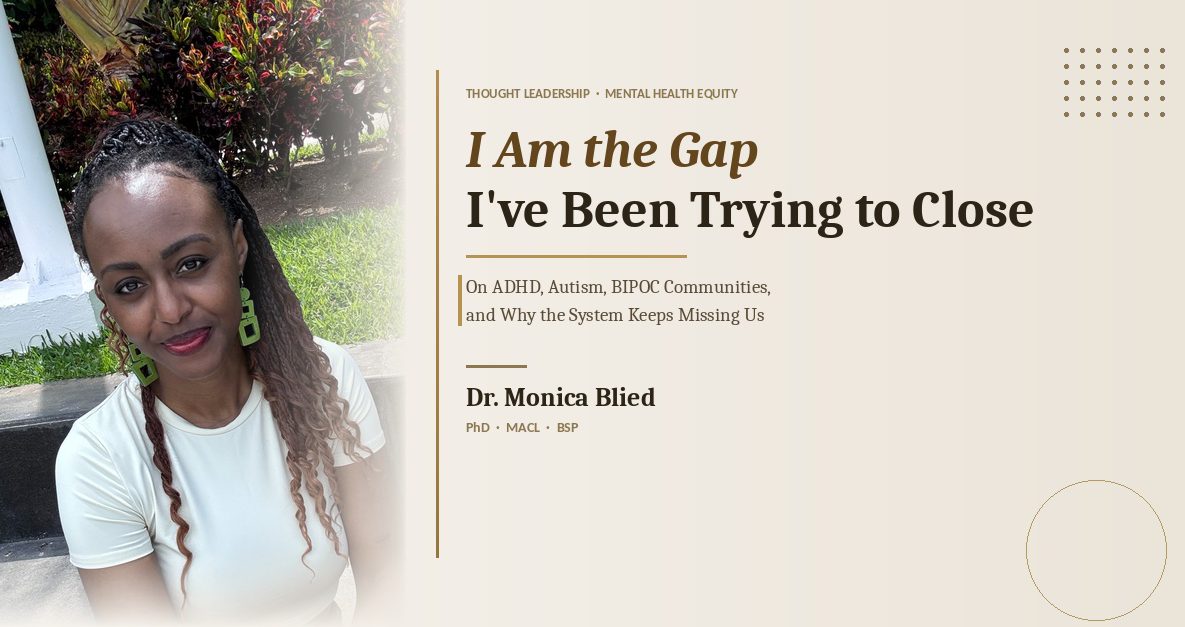
Let me tell you something I don’t say lightly: I am a clinical psychologist who spent years helping people understand their brains before I fully understood my own.
I was late-identified as AuDHD. That is, I live with both autism and ADHD, but did not know until well into my adult life and professional career. I had already earned my doctorate. I had already co-authored journal articles, delivered over 85 presentations and workshops, and built clinical programs from the ground up. I had already been named a Fellow of the APA Minority Fellowship Program — one of eleven in the nation that year. I had already learned, without a map, how to navigate systems that were never designed with someone like me in mind.
And, I had already been living with lupus for over a decade, managing the kind of chronic, unpredictable, full-body stress that most people only read about in research articles.
I was not missed because I wasn’t smart enough or struggling enough on the outside. I was missed, in part, because I was too smart — a pattern familiar to many twice-exceptional, or 2e, individuals, whose giftedness so effectively obscures their neurodivergence that both go unrecognized, sometimes for decades. High achievement reads as evidence that nothing is wrong. Mastery looks like ease. And so the gap between how you appear and how you are actually functioning never quite triggers the concern that might lead someone to look closer. I am proud of everything I built before I had that clarity — and I also know now that I built it carrying something significant that no one, including me, had named yet. I was also missed because the frameworks we use to identify, support, and serve neurodivergent people were not built for a Black woman who masked beautifully, achieved abundantly, and kept going even when her nervous system and her immune system were both working against her.
That is not a personal grievance. That is a systemic pattern. And it is costing us — our communities, our health systems, and our clients — more than we realize.
The Research Is Clear. The Response Has Not Been.
ADHD and autism are not conditions that discriminate by race. But our diagnostic systems, our clinical training, and our mental health tools have — for decades — operated as though they do.
The data tells a consistent story. Black, Latino, and other BIPOC children and adults are diagnosed with ADHD and autism at significantly lower rates than their white counterparts, despite comparable or higher rates of underlying neurodivergence. Research published in Pediatrics and the Journal of Developmental & Behavioral Pediatrics consistently finds that race, socioeconomic status, and provider bias all shape who gets evaluated, who gets diagnosed, and who gets access to support.
The reasons are layered and interconnected: diagnostic criteria historically developed around white male presentations, cultural stigma that reframes neurodivergent traits as behavioral problems or character flaws, providers undertrained in cross-cultural neurodivergence, and communities understandably skeptical of systems that have not historically served them well.
And when diagnosis does happen, it often comes late — after years of being labeled lazy, difficult, dramatic, or defiant. After years of working twice as hard to produce the same output. After years of masking — suppressing, compensating, and performing neurotypicality so effectively that even the people closest to you don’t see the cost.
I know this not only as a clinician. I know it from the inside.
Masking Is Exhausting. Chronic Illness Makes It Harder.
Here is something the research is increasingly confirming, and what many of us have known experientially for a long time: masking is not a coping strategy. It is a survival strategy — and it comes at a significant neurological and physical cost.
For BIPOC individuals navigating systems that require them to code-switch, manage others’ discomfort, and prove their competence in spaces not built for them, masking is rarely optional. It is the price of admission. And when you layer neurodivergence on top of that — an already-taxed nervous system trying to process, regulate, and perform simultaneously — the toll becomes compounded.
Add chronic illness to that picture, and you begin to understand something that healthcare systems are only beginning to grapple with: neurodivergence, chronic illness, and the chronic stress of navigating bias are not separate clinical categories. For many BIPOC individuals, they are one lived reality.
I have lived with lupus since 2012 — fourteen years of learning to work with a body that does not always cooperate, manage a nervous system that processes the world more intensely than most, and show up fully in a profession I love while doing all of it. What that experience has given me — alongside the genuine challenge — is a precision of understanding that no textbook alone could provide.
I know what it means to need tools that work in real life. Not in theory. Not in a controlled study. In the actual, fluctuating, unpredictable terrain of a body and brain that do not follow a predictable schedule.
The Tools We’ve Offered Have Not Been Built for the People Who Need Them Most
This is the part I want healthcare leaders, EAPs, and organizational decision-makers to sit with for a moment.
We have known about the BIPOC neurodivergence gap for years. We talk about cultural responsiveness in clinical training. We acknowledge the role of bias in diagnosis. We cite the research.
And then we offer the same tools — designed for the same audiences — and wonder why engagement is low, follow-through is inconsistent, and outcomes don’t reflect our intentions.
What I kept seeing in my clinical practice, year after year, was not a lack of motivation in my clients. It was a lack of fit between the tools that existed and the lives my clients were actually living. People were given information without systems for follow-through. They were given frameworks without cultural context. They were given one session, or one handout, or one app that assumed a baseline of trust, access, and resource that many of my clients simply did not have.
People do not sustain what they are not meaningfully supported in. And they are not meaningfully supported by tools that were not made for them.
Building What Was Missing
Faces of Health was not born out of ambition. It was born out of necessity.
I built it because I kept watching people fall through a gap that I could see clearly — the gap between what the mental health system offered and what neurodivergent, chronically ill, and BIPOC individuals actually needed. I built it because, as someone who exists at the intersection of all of those identities, I knew exactly what was missing. Not just clinically. Personally.
Years of conducting neuropsychological assessments for ADHD, autism, and specific learning disabilities have shown me, case by case, exactly who the standard system tends to miss and why. AFABs — individuals assigned female at birth — are chronically underidentified, their presentations filtered through diagnostic criteria built almost entirely on research conducted with male subjects. Twice-exceptional individuals are missed for a different reason: their giftedness compensates just enough that the struggle stays invisible until it can’t. These are not edge cases. They are the norm for the communities I serve — and that direct clinical work is what informs everything Faces of Health offers. The assessment process itself has to be as culturally informed and clinically rigorous as everything that follows from it, because getting the diagnosis right is where the work begins.
The Faces of Health ecosystem translates that same neuropsychological depth into brief, practical tools — skills that people can actually use in real life, not just concepts they understand in theory. The ADHD and Autism course is the only resource of its kind that includes a real neuropsychological report, explains diagnostic criteria in plain, affirming language, and was created by a licensed clinical psychologist who is herself neurodivergent. The stress management course and daily-practice app are built on the same foundation: neuroscience, cultural responsiveness, and the understanding that follow-through is not a character trait — it is a design problem.
If the tools are not built for your brain, your body, and your community, the failure is not yours.
What This Moment Requires
We are in a mental health crisis that is disproportionately affecting the communities least served by our current systems. Healthcare organizations, EAPs, universities, and corporate HR teams are all looking for solutions. Many are finding that their current tools — however well-intentioned — were designed for a narrow slice of the population they are now trying to serve.
This is not a moment for incremental adjustment. It is a moment for a different kind of building — tools created by people who understand the gap from the inside, for communities whose experiences have been consistently marginalized in the very systems designed to support them.
BIPOC adults with ADHD and autism are not a niche population. They are a significantly underserved majority within a broader underserved group. They are your employees, your students, your patients, your clients. They are working twice as hard, masking beautifully, and running on fumes — and most of them have never had access to tools that truly fit their reality.
That can change. Not with more awareness campaigns. Not with generic wellness apps. But with clinically grounded, culturally responsive, strengths-based tools built for the brains and lives of the people who have been most consistently left out.
I built Faces of Health because I needed it to exist. I believe the moment we are in is calling for exactly this — and I am committed to making it accessible, scalable, and real.
Dr. Monica Blied, PhD, MACL, BSP is a licensed clinical health psychologist in private practice, assessment psychologist, and adjunct professor of psychology at Pepperdine University. She specializes in neurodivergence, chronic illness, and whole-health care, bringing a health equity lens to communities that have been historically underserved. She is a member of the Medical Advisory Board for LupusLA, a former Fellow of the APA Minority Fellowship Program, and the 2024 recipient of the Distinguished Leadership Award from the California Psychological Association, among other honors.
Dr. Blied is also the founder and CEO of Faces of Health™. Faces of Health is a clinically grounded mental health skills-training platform designed to help employers, healthcare systems, and universities better support people navigating neurodivergence, chronic illness, and stress. When individuals are struggling to keep up—and systems are stretched beyond capacity— the Faces of Health app and online courses provide brief, actionable tools that strengthen executive functioning, support emotional regulation, and promote sustainable well-being.
Learn more at facesofhealth.net and drblied.com/partners.
References:
Aylward, B. S., Gal-Szabo, D. E., & Taraman, S. (2021). Racial, ethnic, and sociodemographic disparities in diagnosis of children with autism spectrum disorder. Journal of Developmental & Behavioral Pediatrics, 42(8), 682–689. https://doi.org/10.1097/DBP.0000000000000996
Coker, T. R., Elliott, M. N., Toomey, S. L., Schwebel, D. C., Cuccaro, P., Tortolero Emery, S., Davies, S. L., Visser, S. N., & Schuster, M. A. (2016). Racial and ethnic disparities in ADHD diagnosis and treatment. Pediatrics, 138(3), e20160407. https://doi.org/10.1542/peds.2016-0407
Executive Functioning Skills Coaching Group
Dr. Blied’s Executive Functioning Skills Coaching Group offers a space to learn and practice practical, brain-based strategies for follow-through in a supportive and affirming environment.
The first cohort ended on March 25th, 2026, and the waitlist for future cohorts is now open.
If you would like to receive updates and registration information when new groups open, you are welcome to join the waitlist. You can also visit drblied.com/adhd to learn more.
In Case You Missed It
This Autism Acceptance Month, I’m thinking about how often autism is missed in BIPOC children.
Not because it isn’t there, but because it’s interpreted as something else first.
In my work as a clinical psychologist, I’ve seen how that misinterpretation can lead to years without the right support.
BIPOC families and autistic individuals, you deserve to be accurately understood and fully included in every space and conversation.
Faces of Health App and Online Courses
Download the Faces of Health app!
This app offers valuable mental health and well-being resources. Download it today from the App Store or Google Play!

Also, be sure to register for my in-depth educational courses at learn.facesofhealth.net:
Empowerment Through Understanding: Adult ADHD and Autism Modules
Dive deeper into ADHD and Autism with this online course to improve self-awareness, self-advocacy, and personal growth. Learn more here.

AND
Beat Stress Using Neuroscience and Mindfulness
Master your mind and body health through neuroscience-based mindfulness and stress management skills. Learn more here.
Dr. Blied’s Assessments
If you are seeking clarity, direction, or support for yourself or your child, I offer comprehensive, strengths-based assessments that honor the whole person.
My evaluations include ADHD, Autism Spectrum Disorder, gifted and twice-exceptional (2e) profiles, mood disorders/differential diagnoses (including bipolar, OCD, anxiety, and PTSD), as well as learning disabilities and learning styles.
I provide remote assessments for residents of New York ages 15+. For residents of California, I offer in-person assessments for ADHD (ages 5+) and autism (ages 9+), with virtual assessment options available for adults.
There are financial support options available for my assessments, including Jonathan Foundation scholarships, HSA/FSA payments, and CareCredit plans.
Visit drblied.com/adhd to learn more!